

Strategies for Organizing Cross-Disciplinary Source Material
- Hierarchical Tagging: Organizes sources into nested folders or with multi-level tags. Best for structured subjects, enabling granular classification and retrieval based on clear categories.
- Relational Database: Employs software to create interconnected records for sources. Allows powerful querying and manages complex relationships between diverse source types and research themes.
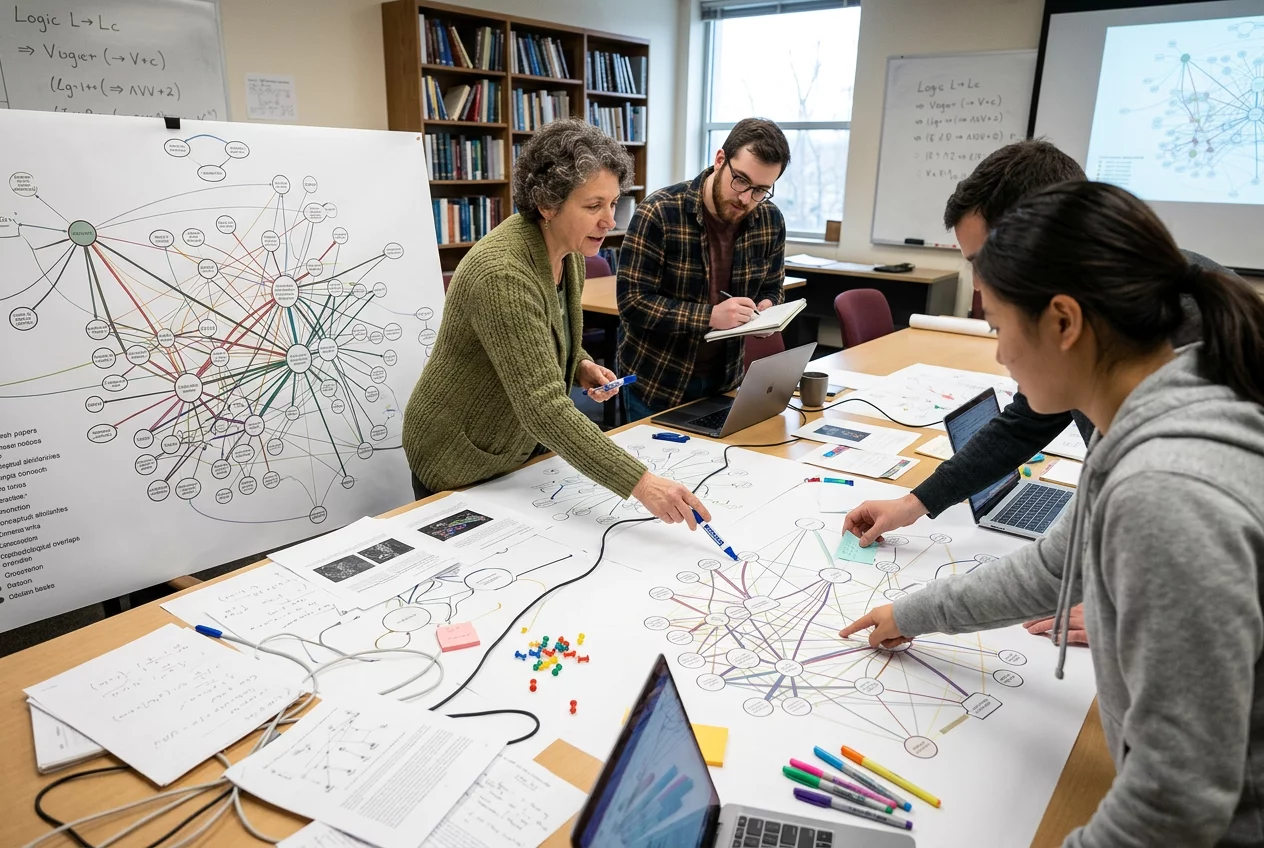
- Mind Mapping: A visual approach linking sources to central themes and ideas, forming a web of connections. Excels at illustrating conceptual relationships and fostering holistic understanding of material.
Evaluation Criteria for Source Organization
- Scalability & Complexity: How well the method handles increasing source volume and intricate connections in interdisciplinary research.
- Interoperability & Portability: Ease of data exchange between tools or export for future use, vital for long-term projects.
- Setup & Learning Curve: Time and effort needed to implement the system and for users to gain proficiency.
- Collaboration & Sharing: Effectiveness in facilitating teamwork, enabling multiple contributors to access and modify shared materials.
Comparative Analysis of Organization Strategies
Hierarchical Tagging offers decent scalability for focused projects, organizing sources into clear categories. However, managing complex, cross-disciplinary connections is challenging; intricate relationships often require cumbersome duplication, limiting effectiveness for integrated research.
For interoperability, simple file structures are highly portable. Advanced tagging systems might face migration issues. The initial setup is straightforward. Collaboration via shared drives works, but concurrent metadata editing can lead to inconsistencies; robust version control is vital for team integrity.
Relational Database Management excels in scalability and handling complex, cross-disciplinary material. It enables intricate relationships between sources, concepts, and arguments, ideal for large, diverse datasets. Robust querying capabilities uncover nuanced connections efficiently.
For interoperability, database exports are standardized, but importing into other systems may require custom scripts. The initial setup demands a steeper learning curve, needing database design knowledge. Strong built-in collaboration features like user roles and concurrent editing make it highly effective for team projects. ZetaRef Library can assist with this.

Mind Mapping offers excellent visual clarity for conceptualizing complex relationships, especially early in interdisciplinary research. Its scalability can be limited by the visual canvas, potentially becoming cluttered. However, it intuitively handles complex connections by linking ideas directly, fostering a holistic overview.
Interoperability for mind maps varies; some tools offer export options, but full functionality often remains proprietary. The initial setup is generally quick and intuitive. Collaboration features range from basic sharing to real-time co-editing in advanced tools, making it adaptable for team-based conceptualization.
Recommendations for Method Selection
For theses with clearly defined disciplinary boundaries and a moderate volume of sources, Hierarchical Tagging is a practical choice. It offers a low barrier to entry and straightforward organization. This method is particularly suitable for individual researchers or small teams with established communication protocols, ensuring consistent tagging.
For theses with extensive cross-disciplinary connections, large diverse sources, or robust querying needs, Relational Database Management is highly recommended. It suits complex projects and larger research teams benefiting from strong collaboration features. ZetaRef Library can assist in structuring such complex data effectively.
When the primary goal is to visually explore and conceptualize intricate relationships between disparate ideas, Mind Mapping is invaluable. It excels in initial brainstorming, hypothesis generation, and understanding the overarching structure of interdisciplinary arguments. This method complements others by providing a high-level conceptual overview.


0 Comments