
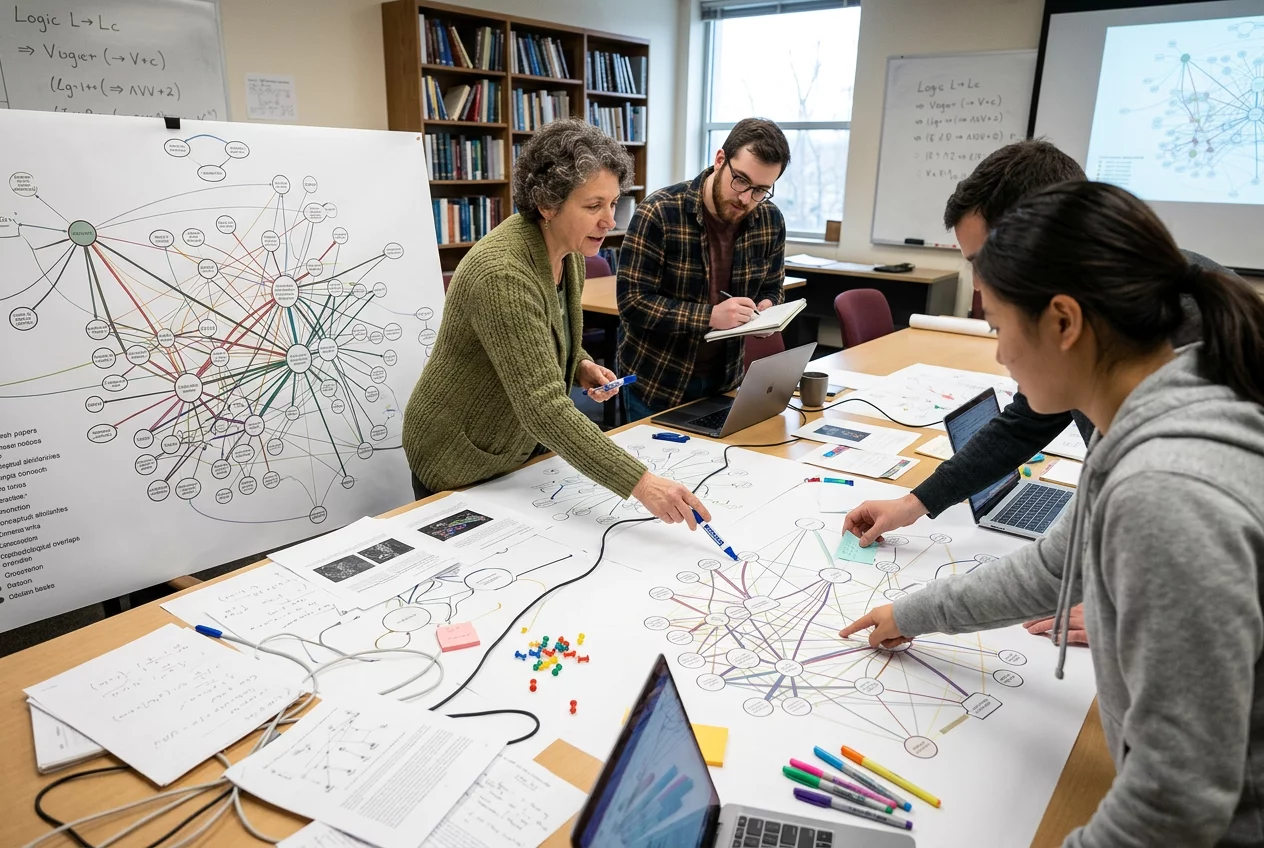
Key Approaches for Knowledge Mapping
Below are fundamental approaches for understanding how research papers connect, each offering distinct advantages for various analytical goals.
Citation Network Analysis
This method systematically maps relationships by examining how research papers reference each other. It uncovers direct influences, historical pathways, and structural patterns within academic fields, showing idea lineage.
Semantic Content Analysis
Leveraging natural language processing, this approach identifies conceptual links and thematic similarities across diverse papers. It reveals hidden connections based on shared terminology and underlying ideas, independent of citations.
Hybrid Approaches
These methods integrate both citation data and semantic content analysis for a more comprehensive view. Combining structural influence with conceptual proximity offers a richer, multi-layered understanding of knowledge connections.
Evaluation Criteria for Method Comparison
When selecting a method, consider these key aspects to align the approach with your research objectives.
Granularity of Insight
How detailed are the connections identified? Does it reveal subtle or only broad links between research works?
Scalability
How efficiently does the method process very large datasets? Is it computationally feasible for extensive academic corpora?
Bias Susceptibility

To what extent can the method be influenced by publication trends, disciplinary norms, or data limitations?
Resource Intensity
What level of computational power, specialized software, and human expertise is required for effective implementation?
Comparative Analysis of Knowledge Mapping Methods
Citation analysis excels at revealing direct influence and historical trajectories, offering clear, traceable paths. Granularity might miss implicit, non-cited conceptual links. For scalability, it's efficient with large datasets; citation links are explicit and machine-readable, simplifying graph construction for broad overviews.
This method is susceptible to publication bias, where highly cited papers may overshadow less visible works. It often favors older papers with accumulated citations. Resource intensity is low; standard graph databases and tools are usually sufficient, requiring moderate computational resources for network processing.
Semantic analysis offers high granularity, uncovering thematic relationships even without direct citations. It identifies shared concepts across disparate fields. Scalability is challenging; processing large text volumes with advanced NLP models demands significant power and time, limiting application to vast corpora.
Bias in semantic analysis can stem from NLP model training data quality, potentially reinforcing linguistic conventions. It is less susceptible to citation-specific biases. Resource intensity is high, requiring powerful computational infrastructure, specialized NLP expertise, and extensive text pre-processing.
Hybrid methods combine strengths, offering superior granularity by cross-validating explicit citations with implicit semantic links, revealing a richer tapestry. Scalability is complex; integrating disparate data types requires sophisticated frameworks and significant computational resources. They mitigate biases but demand expertise in network science and NLP for robust data fusion.
Recommendations for Method Selection
When the primary goal is to trace the historical development of ideas, identify influential works, or understand direct academic lineage, Citation Network Analysis is often the most appropriate choice. Its straightforward nature and relative computational efficiency make it ideal for broad structural overviews within well-established research domains.
If the objective is to uncover novel, non-obvious connections between disparate fields or identify emerging themes before widespread citation, Semantic Content Analysis is highly valuable. For a holistic view that combines both, Hybrid Approaches offer the most robust and nuanced mapping, revealing a richer context for research discovery. ZetaRef Library helps facilitate these advanced analyses.
The selection of a method should align with available resources and the desired depth of insight. For rapid, high-level mapping, citation analysis is efficient. For detailed conceptual exploration, semantic analysis is superior. For the most comprehensive view, hybrid models, though demanding, offer unparalleled clarity. Consider your specific project scope with ZetaRef Library.


4 Comments
Jerome Williams
This article provides a very clear and concise overview of complex methodologies. The comparison section is particularly helpful for understanding the trade-offs.
Kelly Moore
Thank you for your feedback! We aimed for clarity to help researchers navigate these important choices. We're glad you found the comparison useful.
Emerson Meyer
While the article covers the methods well, I'd be interested in seeing specific examples of how ZetaRef Library implements these approaches in practice.
Parker Nichols
That's a valuable suggestion. We plan to release follow-up content detailing practical applications and case studies where ZetaRef Library tools have been instrumental. Stay tuned!